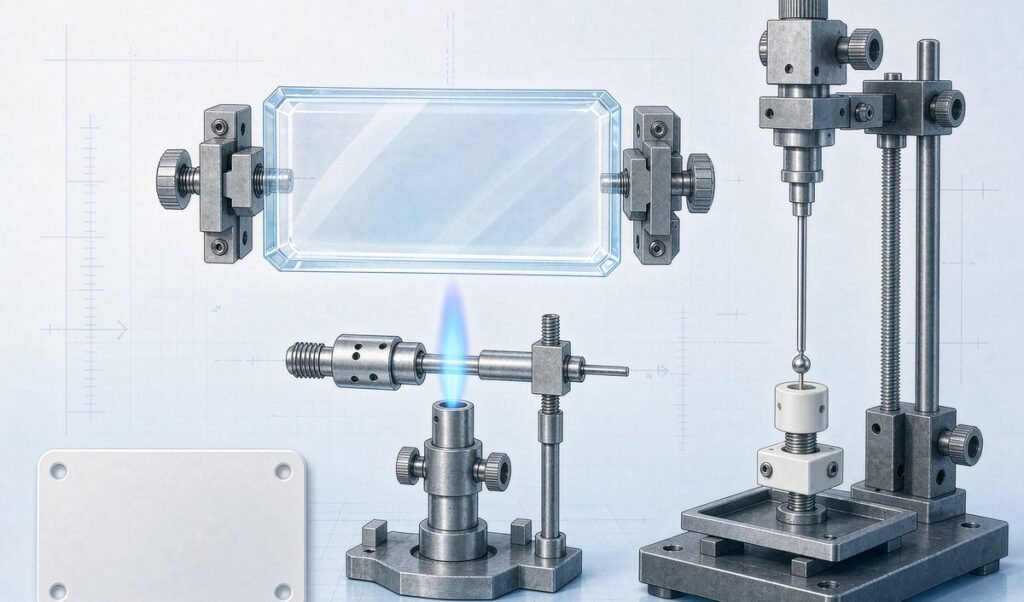
A luminaire cannot be sold into most commercial or public buildings unless the whole assembly passes a flammability assessment. The optic is part of that assembly. When an LED diffuser is the largest plastic surface in the fixture, it is often the component that decides whether the enclosure requirement is met.
This article explains what the common fire ratings actually measure, why polycarbonate and PMMA behave differently in them, and what to ask a supplier for instead of accepting the phrase “flame retardant”.
The ratings that appear in tender documents
UL 94 is the plastics flammability standard. Its classifications run from HB, a slow horizontal burn, through V-2, V-1 and V-0, which are progressively more demanding vertical burn tests judged on self-extinguishing time and whether flaming drips are produced. 5VA and 5VB are the most severe and involve a plaque burn-through test.
Glow wire ignition, IEC 60695-2-11, presses a heated element against the material at a specified temperature, commonly 650 °C, 750 °C or 850 °C, and judges the result on whether ignition occurs and how long any flame persists.
GWFI and GWIT, short for glow wire flammability index and glow wire ignition temperature, give threshold values rather than a single pass or fail at one temperature.
Which of these applies depends on the end-product standard and the market, not on the material supplier. A fixture destined for a European office and one for a North American warehouse may both be described as “flame rated” in conversation while being assessed by entirely different methods.
Why PC and PMMA are not interchangeable here
Polycarbonate tends to char and self-extinguish, and flame-retardant PC grades are the usual answer when a demanding classification is required at a thin wall. PMMA (acrylic) burns more readily and drips, so reaching the same classification generally needs thicker sections or specifically modified grades. That difference is one reason the two materials are not swapped casually even when their optical behaviour allows it. The comparison is set out in polycarbonate diffusers, PMMA acrylic and PC vs PMMA for LED lighting.
The practical point is to confirm the fire requirement early if the optic was already chosen for optical reasons. Discovering it late can force a material change, and a late material change is where requalification cost comes from.
Thin wall is the hard case
Fire classifications are thickness-dependent. A material that achieves V-0 at 3.0 mm may only reach V-2 at 1.5 mm, and the listing for the specific grade states exactly which thickness was assessed.
Extruded LED profiles are thin-walled by nature. Depending on cross-section they run from well under 100 grams per metre into the hundreds, so the wall thickness that matters for your profile is often far below the headline figure quoted in a datasheet. Ask for the classification at your production wall thickness, and ask which thickness the certificate covers.
What to ask your supplier for
“Flame retardant” or “V-0 material” is not an answer. Request the following, in writing:
- The test report, from an accredited laboratory, for the specific grade being supplied.
- The thickness the classification applies to.
- The colour that was tested. Some listings are specific to colour or pigment, and white diffuser compounds are not always covered by a natural-colour listing.
- Whether the grade is halogenated, if your market restricts halogenated flame retardants.
- Confirmation that production material continues to match the tested formulation, batch to batch. That is a quality management question more than a material one, and our incoming inspection checklist shows how that consistency is verified before material reaches an extruder.
The constraint worth stating plainly
No diffuser supplier can certify your luminaire for you. Marks such as UL, ENEC or CCC are issued against the complete assembled product by the body assessing that product. What an extrusion supplier can do is run a controlled process, supply material whose listing covers your requirement, and provide the documentation your own submission needs.
We work to ISO 9001:2015, described on the quality control page. Specific fire ratings come down to choosing the correct grade up front and verifying it batch by batch, so state what you need on the drawing rather than leaving it to assumption. How to send a drawing for a custom LED diffuser lists what that submission should include. Where a PC grade is being considered, start from the PC LED diffusers product range.
Frequently asked questions
Is V-0 always necessary?
No. The required classification comes from the end-product standard rather than from the material. Over-specifying narrows the material choice and can cost you optical performance for no benefit.
Does a frosted or opal finish change the classification?
Usually the base polymer governs the result, but pigments and diffusion additives can affect behaviour. Listings are often colour-specific, so ask for the one matching your finish.
Which thickness will the certificate cover?
Whichever thickness the laboratory actually tested. Ask for the certificate rather than the datasheet summary, and check the figure against your own profile wall.
Tell us the target classification, wall thickness and destination market, and we will identify which compound fits and quote it. Request a quote.