A diffuser profile that leaves the line in perfect condition can arrive warped, scratched or dusty enough to fail an incoming check. The damage almost never happens inside the factory. It happens on the way to the container, in the container, and in the last few minutes before the fixture is assembled.
This is what actually goes into packing extruded PC and PMMA profiles, what the damage looks like when it goes wrong, and which lines you should add to a purchase order so the responsibility for transit damage sits somewhere specific.
What goes wrong in transit, and how
There are four recurring failure modes, and each one points at a different packing decision.
Scratching and scuffing. Profiles rub against each other or against the carton wall when a pallet shifts. On a clear or lightly frosted profile, one rub mark is visible in the finished luminaire, so a whole length becomes scrap at the customer end. The fix is a slip layer between every profile and a soft interface at every carton wall.
Warping and bow. This is the one buyers rarely anticipate. A long profile is never perfectly straight; it has a natural bow. Stack weight above a tolerance threshold, heat inside a sealed container, or both together will press that bow in permanently. Once a profile is bowed past what the fixture housing can absorb, it will not seat correctly in the channel.
Dust and contamination. An open carton on a loading dock in a humid port collects fines that end up as bright specks on a diffusing surface. The fix is simple and cheap: sealed inner packaging.
End damage. Cut ends get chipped when cartons are dropped. On a snap-in profile, a chipped end cannot be pushed into the housing, so the last piece of a length is lost.
How the profiles are actually packed
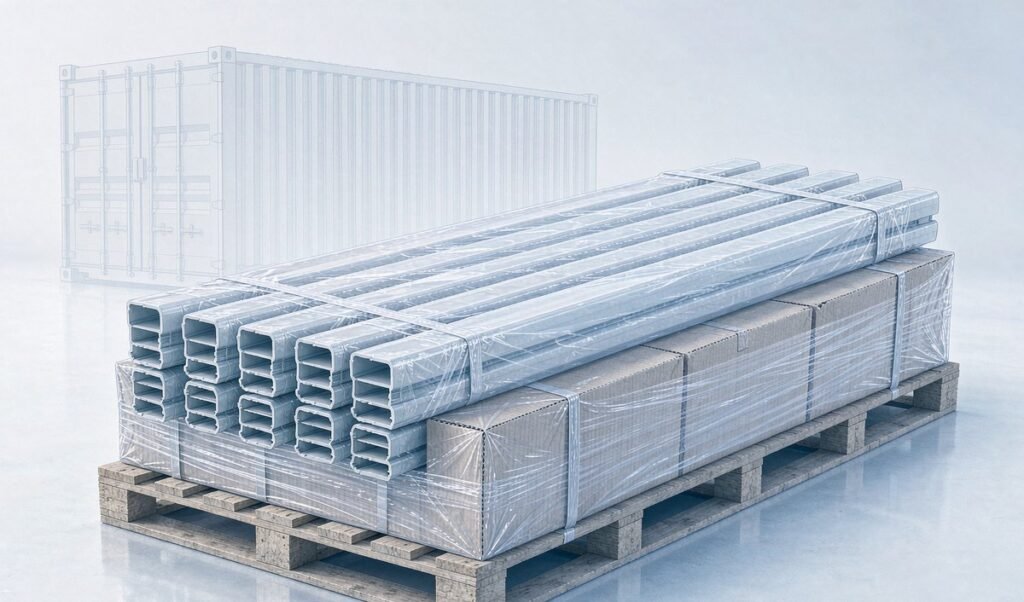
A standard export packing for linear profiles looks like this, working from the profile outward.
Each profile is wrapped individually in a PE film or a protective paper, with the slip layer oriented so the diffusing face never contacts the next profile. Some suppliers add a printed edge protection strip along the two long edges, because that is where handling damage concentrates.
Wrapped profiles are grouped into bundles with a fixed count and a fixed total length, so the customer can plan a cut list against the bundle rather than counting pieces. End caps or foam blocks close both ends of each bundle so cut edges stay clean and the bundle does not telescope.
Bundles go into a carton sized so nothing can shift, and cartons are stacked on a pallet with the load spread across the deck. A common mistake is to build the pallet tall and narrow. A tall stack compresses the bottom bundles and turns a small container movement into a bow.
The pallet is then strapped and, for sea freight, often stretch wrapped. For long shipments the cartons themselves are sometimes marked with handling instructions, which helps at the port more than it helps in the factory.
What to specify in the purchase order
Packaging is one of the few quality items a buyer can fully control through paperwork, because the specification is the acceptance criterion. These are the lines worth adding.
State the protection requirement for the diffusing face, not just “protect from damage”. Ask for a slip layer between every profile and say that contact between two diffusing faces is not acceptable.
State the maximum stack height or the maximum number of bundles per carton, in the same way you would state a dimensional tolerance. This is the single line that prevents most bow complaints.
State the bundle length and count so the cut list at the receiving end is predictable, and ask that the bundle count be printed on the carton.
Ask for sealed inner packaging, and ask that cartons be labelled with the profile code and the bundle quantity. When a dispute arises, the label is the evidence.
If the order includes both PC and PMMA, ask that they are packed in separate cartons and marked. Mixing materials in one carton is a reliable way to get the wrong profile onto the wrong assembly line later.
How to check it on arrival
Packaging quality is visible before you open a single bundle. Look at the carton condition first: crushed corners mean the pallet was dropped, and the profiles inside should be treated as suspect even if they look fine.
Open one carton from each pallet rather than all of them, and take the bundle from the bottom layer, because that is where compression damage appears first. Lay a length on a flat surface and sight along it. A visible bow is not automatically rejectable, but it should be measured and compared against the drawing tolerance, which is the same tolerance you would apply to the extrusion itself.
Check the diffusing face for rub marks and fines under a light. If a supplier’s packing passes this check once, it will usually pass again, so it is worth doing properly on the first shipment and recording the result. The full receiving routine is covered in the incoming inspection checklist.
Where packaging sits in the bigger picture
Packing is not a substitute for process control. A supplier that cannot hold transmittance and gram weight steady across a batch will not suddenly become reliable because the cartons are neat. What good packing does is protect the quality that was already built into the profile, which is the same reason the factory controls quality at the line and not at the dock.
If your current supplier has never discussed packing with you, that is usually a sign the export side of the business is thin, regardless of how the extrusion looks. When you request a quote, ask for the packing spec alongside the profile drawing. A supplier who can send one without thinking has shipped before. One who has to invent it on the spot probably has not.
Packing detail is worth confirming early for a custom profile, because end caps and bundle lengths are set at the packing bench rather than in the die, and the earlier they are agreed the fewer arguments happen at the dock. It also interacts with lead time, since a packing change late in production can hold a whole shipment for a day. Bundle length is also the reason a supplier can quote a consistent batch count without opening the carton, and it is what makes a standard profile order straightforward to receive against a drawing.