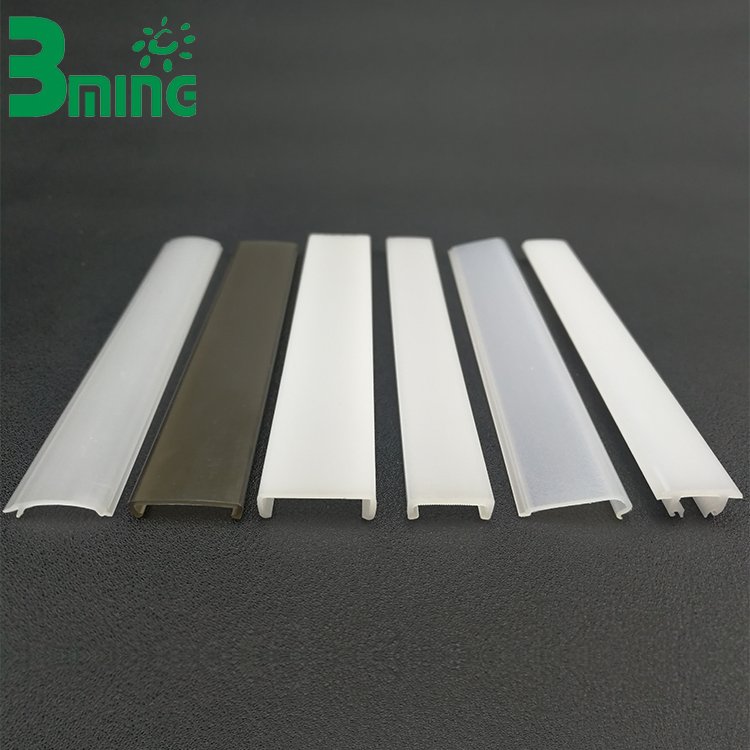
Polycarbonate and PMMA are the two materials almost every extruded LED diffuser is made from. Neither is universally better — the right choice depends on what the fixture has to survive and how the finished surface has to look.
Why the choice matters
The material sets the ceiling on what a diffuser can do. It determines how much light gets through, how the surface feels and wears, how the profile behaves in heat and UV, and how it responds to an impact. Switching material later usually means new tooling trials, so it is worth settling early in the project.
Polycarbonate: impact and temperature first
Polycarbonate is specified when the diffuser has to survive abuse or heat. Its impact strength is very high and its continuous service temperature is higher than PMMA, which is why it is the standard for industrial fixtures, vandal-resistant luminaires and many outdoor applications. UV-stabilised and flame-retardant polycarbonate grades are available where the installation demands them. The trade-offs are slightly higher haze, a slightly warm tint and a softer surface that needs care in handling and packing.
PMMA: clarity, hardness and colour stability
PMMA, usually called acrylic, is chosen where the appearance of the finished profile matters. It is water-clear, takes a hard and scratch-resistant surface, and has very good UV stability with low yellowing — which is why it dominates architectural interiors and outdoor signage. Its impact strength is moderate compared with polycarbonate.
Side-by-side comparison
| Polycarbonate (PC) | PMMA / acrylic | |
|---|---|---|
| Optical characteristics | Very good transmission, slightly higher haze | Excellent clarity, low haze |
| Impact resistance | Very high | Moderate |
| Surface finish | Good; softer surface needs care | Hard, scratch-resistant |
| Appearance | Slightly warm tint | Water-clear |
| UV stability | Good with UV-stabilised grades | Very good, low yellowing |
| Typical applications | Industrial, outdoor, vandal-resistant | Architectural, commercial, signage |
How to decide
Start with the failure mode you cannot accept. If the diffuser will be hit, washed with solvents or mounted somewhere hot, polycarbonate is usually right. If it will be looked at closely, needs to stay clear for years, or sits in daylight, PMMA is usually right. Where both matter, two-colour co-extrusion can combine the properties in one profile.
The final answer should come from trial lengths in your own fixture rather than a data sheet: transmission, diffusion and appearance all depend on the profile geometry as well as the resin.
Related products and applications
Need this profile made to your drawing?
We extrude PC and PMMA diffusers, covers and lenses from your drawing, sample or photometric target. Tooling is developed in-house.
Frequently asked questions
Is PMMA the same as acrylic?
Yes. PMMA is polymethyl methacrylate; acrylic is the common trade name.
Can I switch from PC to PMMA without new tooling?
Usually not without re-qualification. The two materials shrink and flow differently, so the die and the process settings need checking.
Which material is better outdoors?
PMMA has better natural UV stability and lower yellowing; UV-stabilised polycarbonate grades are used where impact resistance is also required.