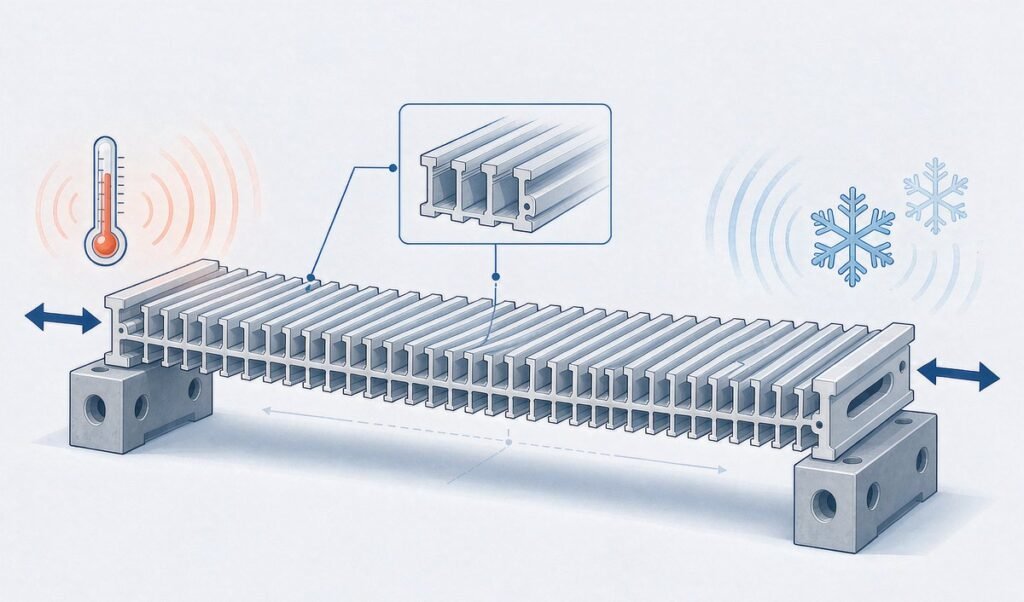
Diffuser profiles are specified in millimetres, but they live in a temperature range. A fixture that works perfectly in a 20 degree lab can sag in a warehouse in summer, and the same profile in PMMA can crack when a lens is installed in a cold store in winter. Both are temperature problems, and neither shows up in a drawing review.
This is what heat and cold actually do to an extruded profile, which material is exposed to which failure, and what to ask a supplier so the answer comes back as a number rather than as reassurance.
Heat: expansion and sag
Every plastic grows when it warms. The growth per degree is small, but a two metre profile in a sealed housing accumulates it, and a fixture that was designed with no clearance at the ends converts that growth into buckling or into pressure on the lens retention. The drawing tolerance you agreed for a straight length does not cover this, because the tolerance applies at a reference temperature that nobody writes down.
The second and more visible effect is sag. A long unsupported span under its own weight sags more when the material softens with heat, and the sag does not fully recover on cooling. In practice this shows up as a profile that looks fine lying flat on a bench but bows away from the housing once it is installed in a warm ceiling void.
Sag depends on three things together: the span between supports, the gram weight of the profile, and the temperature the housing actually reaches. That last number is the one that surprises people. The air around the fixture is one thing; the temperature inside a sealed enclosure above the LED board is another, and it is the internal temperature that softens the material.
Cold: impact and brittleness
Cold failure is the opposite problem and it is material dependent. PMMA gets noticeably less forgiving at low temperature. A profile that survives a drop test at room temperature can chip or crack from the same impact after a night in an unheated warehouse, and the crack usually starts at a cut end or at a notch in the snap-in leg.
PC holds impact resistance at low temperature better than PMMA, which is one reason PC is the usual choice for fixtures that live in unheated spaces. The trade is already covered in material comparison, but the practical version is short: if the fixture will see freezing temperatures during shipping or storage, and especially if it will be handled at those temperatures, say so on the enquiry rather than choosing the material on transmittance alone.
Cold also matters for installation. A profile that has been stored in a cold container is stiffer and more notch sensitive than the same profile at room temperature, and most transit damage of this type happens in the first hour after unloading rather than during the voyage itself.
How to specify against it
You cannot stop thermal expansion, but you can stop it from becoming a warranty claim. The specification is mostly about giving the material somewhere to go.
Ask for the service temperature range of the profile as a data sheet line, and compare it against the temperature the housing reaches rather than the ambient temperature of the room.
Ask for support spacing guidance at the longest span in your design, in the same units you use for the fixture drawing. This is the single most useful number for preventing sag, and it costs the supplier nothing to provide.
Ask for the coefficient of thermal expansion, and then do the arithmetic for your longest length. If the growth over your temperature range is more than a fraction of the clearance you designed at the ends, the clearance is the part that needs changing.
For cold exposure, ask for a low temperature impact statement for the specific material and wall thickness, not a generic claim about the material family. Wall thickness changes impact performance substantially, which is the same reason thickness matters in flame rating discussion.
If the profile will run in a warm enclosure for years, ask whether a co-extruded cap is used and how it behaves at the upper end of the range. The cap is there to protect the surface from UV and weathering, and its contribution to the surface layer is what yellowing discussion covers.
Where this shows up in the field
Outdoor and semi-outdoor fixtures are the usual casualties. A signage application with a long run of cover in a metal housing sees both effects in one day: expansion at midday and contraction at night, with the housing holding heat after sunset. Industrial fixtures in high bays have the same story with more heat and longer spans.
The common thread is that the profile is asked to do something it was never specified for, because the drawing review looked at dimensions and not at temperature. A profile chosen with the support spacing and the temperature range on the same page as the cross section is a profile that behaves the same in July as it did in the sample.
If you are not sure which material suits the thermal duty, material comparison is the place to start, and the tolerance specification is where the dimensional side of the same question is handled. For one market where these questions shaped the offer, the Korea EXPO 2024 recap covers what fixture builders asked about long-run thermal duty.