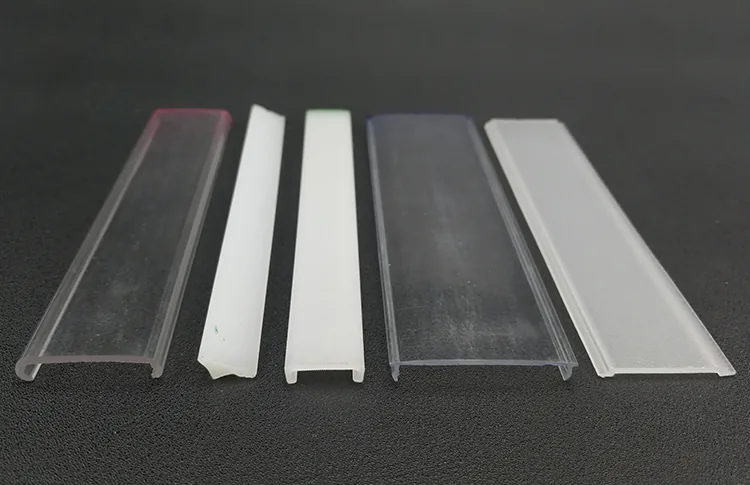
A PMMA diffuser can arrive as a flat sheet or as an extruded profile, and both are called the same product in supplier catalogues. They behave differently in a fixture, and the cost gap between them at your volume is often wider than buyers expect. Pick the wrong form and you either pay tooling you never recover, or you keep buying cut panels that drift in size batch after batch.
This page sets out what each form does well, where each one loses, and the checks to run before you order. If you are still settling the resin itself, the pc vs pmma led diffuser comparison covers the material trade off first, and the PMMA acrylic material page lists the compounds we run.
What a PMMA diffuser sheet does best
A sheet is flat stock, typically supplied in panels or strips that you cut, drill or bend to fit the housing. Its main advantage is that it exists before your project does. No die, no section drawing, no prototype round. You order a thickness and a diffusion grade, cut it to the panel size in your fixture, and you are done.
That makes sheet the right call in three situations:
- Flat or nearly flat light windows. Troffers, panel retrofits and signage faces take sheet directly. The cover is a rectangle, so a rectangle is what you buy.
- Small and early volumes. Before a fixture proves itself in the market, buying sheet and cutting it in house keeps cash out of tooling.
- Replacement and service stock. When the original part is discontinued or the housing takes a standard opening, cut sheet is often the only practical spare.
The limits show up in the housing, not in the optics. A flat sheet cannot snap into a channel, wrap a curved housing, or add stiffening ribs where a long span sags. You fix it with frames, clips and brackets, and every added fastener is a light leak and an assembly step.
Sheet also carries the diffusion grade in the material itself, so the whole panel diffuses evenly whether it needs to or not. If your fixture only needs diffusion on the face and clear material on the snap edges, sheet gives you no way to separate the two.
What an extruded PMMA profile does best
An extruded profile starts from a section drawing. The cross section can put a diffusing face exactly where the LEDs sit, keep clear or frosted material on the legs that grip the housing, and add snap features, ribs or stiffeners in the same continuous part. The compound and wall thickness set the light transmission, which can be specified anywhere from 0% to 97% depending on the section and the grade.
Because the part is extruded continuously, length is a cutting decision rather than a moulding limit. Sections run in profile weights from 10 g/m to 2000 g/m, so the same logic covers a thin strip channel cover and a heavy linear housing lens. Once the die exists, every metre is repeatable, which is what keeps a fixture family consistent across production years.
Where a profile earns its tooling:
- Linear fixtures with snap in covers. The legs and the diffusion are one part, and assembly is a press fit.
- Curved or wrap around covers. Dome, tube and wing sections cannot be cut from flat stock without seams and weak points.
- Volume production. Above a few hundred pieces, the per piece cost of an extruded section falls below cut sheet, and the gap widens with every batch.
The trade off is the die. A profile needs a section drawing, a tool and a sample round before the first production metre. If the fixture may never pass a few hundred pieces, that cost is a bet.
Side by side
| Factor | PMMA diffuser sheet | Extruded PMMA profile |
|---|---|---|
| Upfront cost | None beyond material | Section design and die |
| Minimum practical order | Any quantity you can cut | 500 pieces is the normal floor for a production run |
| Cross section freedom | Flat only, formed by hand if at all | Any section the die can hold, including snaps and ribs |
| Diffusion placement | Even across the whole panel | Where the section puts it, face only if wanted |
| Length | Cut from panel sizes you buy | Continuous, cut to length in production |
| Batch consistency | Depends on your own cutting accuracy | Set by the die, repeats across batches |
| Unit cost at volume | Stays flat or rises with labour | Falls once volume covers the tool |
| Best fit | Troffers, panels, spares, early builds | Linear families, curved covers, steady volume |
How to decide: checks you can run
Put the housing and the forecast on the table and answer four questions in order:
- Geometry. If the light window is a flat rectangle and nothing needs to snap, sheet is usually enough. If the cover must grip, wrap or stiffen the housing, a profile is the only clean answer.
- Volume. Compare cut sheet cost at your real annual quantity against profile cost plus the die. Somewhere near the 500 piece mark the profile wins, and past a few thousand pieces it is not close.
- Optical control. If the LEDs need a specific beam treatment, for example hiding dots at a short mixing distance, a diffusing face on a defined section beats a fully diffusing panel. For beam shaping rather than diffusion, that moves the part toward a lens, and the LED lens beam angle selection guide covers that path.
- Service life. If the fixture will need spare covers for years, a profile with a stable part number is easier to resupply than cut sheet that depends on whoever holds the shears.
One caution on appearance: a sheet and a profile using the same grade of PMMA acrylic can still look different in the fixture, because thickness and surface texture change how the diffusion reads. Approve samples of the actual part, not samples of the material.
Ordering realities
Production runs on 20+ extrusion lines, with daily output above 10,000 pieces once a profile is in regular production. The minimum order is 500 pieces per part. Quality is audited to ISO 9001:2015 (CQC certificate 00124Q34175R1S/3300, valid to 2027-05-16). Flammability, RoHS and electrical requirements must comply with the standards your destination market asks for, and the UL Component Plastics yellow cards E242424 and E300275 are material level recognitions, not approvals of an assembled fixture.
Length is handled in production rather than by hand. The custom cut to length process covers tolerances and packaging for finished lengths, so the profile arrives ready for the line instead of as raw stock.
For sheet stock, replacement covers and standard openings, the led light covers page lists what is kept in cut sizes. For profiles already running, the PMMA LED diffuser product page shows the PMMA lighting diffusers in current production, and most of them started as a customer section drawing.
If the housing is decided and the quantity is known, request a quote with the section drawing or the panel dimensions, and both paths can be priced side by side.
Frequently asked questions
Can a PMMA diffuser sheet be bent into a profile shape?
Partly. Gentle curves can be heat formed in house, and many shops do it for one off retrofits. What forming cannot give you is snap legs, ribs or repeatable geometry, so it works for looks and fails for production. If the shape needs features, it needs a die.
At what quantity does an extruded profile become cheaper than sheet?
It depends on the section, but around the 500 piece minimum order the comparison usually turns. Ask for both prices against the same drawing and the same annual quantity, and include your own cutting labour in the sheet side, since that is where sheet cost hides.
Do sheet and profile use the same PMMA compound?
Often the same family of compounds, but the grades differ. Extrusion grades are chosen for melt behaviour at the die, sheet grades for flatness and thickness control. Light transmission is set per grade, so compare figures measured on finished parts rather than assuming the datasheet carries across.
I only have a sample of the old cover. Can you make a profile from it?
Yes. A sample plus the housing it came from is enough to reverse the section, then you approve a drawing before any die is cut. Send the sample dimensions and the fitting photos when you request a quote, and flag whether the original was diffusing on the face only or all round.