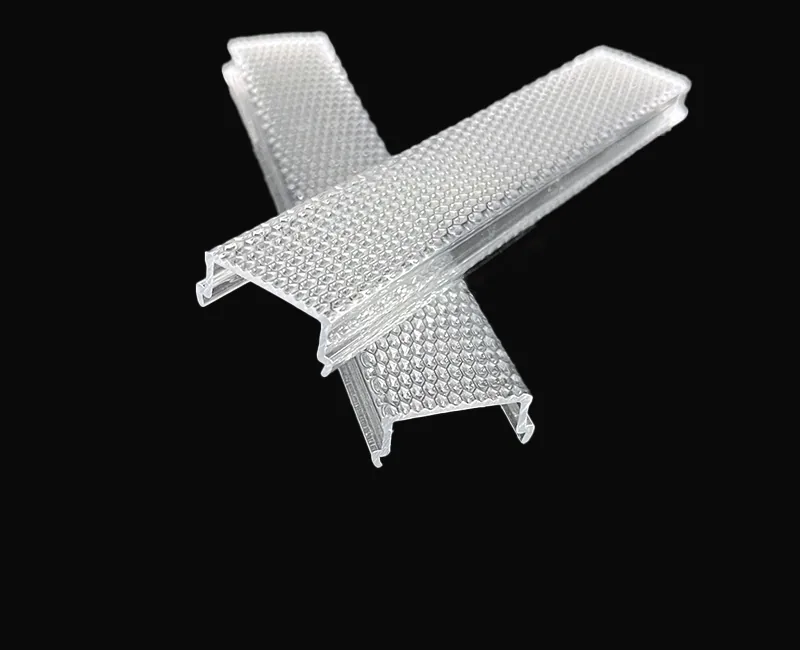
Two covers can both be called prismatic and still throw completely different light. The difference sits in two numbers that most enquiry sheets leave out: pitch and prism angle. Pitch is how far apart the prisms sit. Prism angle is the shoulder angle of each prism. One sets how finely the surface breaks up the light, the other sets where that light goes. Get them wrong and you find out after the luminaire is assembled, when the beam is too wide, the LEDs show as dots, or the fitting fails a glare check.
This page explains what each number does, how they interact, and what to agree with your supplier before a die is cut. If you want the basic anatomy of the part first, the prismatic LED diffuser explainer covers structure and materials, and the prismatic light diffuser product page lists the sizes that run in production.
What pitch and prism angle actually mean
Pitch is the centre to centre distance between two neighbouring prisms, measured in millimetres. A 2 mm pitch puts five prisms under every centimetre of cover; a 5 mm pitch puts two. Fine pitch means more refracting events per millimetre and a smoother looking surface. Coarse pitch means fewer, larger facets that you can see and count.
Prism angle is the angle at the shoulder of each prism, measured from the base plane. It decides how sharply each facet bends the light that crosses it. A shallow shoulder passes most light straight through and nudges a little of it sideways. A steeper shoulder grabs more of the ray bundle and throws it further off axis.
The two numbers do different jobs, and a drawing that gives one without the other is incomplete. Pitch without angle leaves the beam undefined. Angle without pitch leaves the appearance undefined, because pitch is what your eye reads as texture.
How pitch changes the beam
Pitch mainly controls three things: how well the cover hides the LEDs behind it, how much light gets through, and how crisp the beam stays.
| Pitch band | LED hiding | Transmission | Beam behaviour | Typical use |
|---|---|---|---|---|
| Fine, roughly 0.5 to 1.5 mm | Hides close LEDs well, even at short mixing distances | Lower, each facet costs a little light | Wide, soft, hard to see any structure in the beam | Linear fixtures with exposed diodes, close to the eye |
| Medium, roughly 1.5 to 3 mm | Hides LEDs at moderate distances | Middle ground | Controlled spread with some direction left | Troffers and office linear fittings |
| Coarse, above 3 mm | LED dots can show if mixing distance is short | Highest of the three | Most light stays on its original path, facets add visible structure | High output fittings where efficiency dominates |
The trade to keep in mind: every facet is a surface that light can refract at or reflect off. More facets per millimetre means more chances to redirect light where you want it, and more chances to lose a little of it. That is why a fine pitch cover dims the luminaire slightly and a coarse one does not, and why the right answer depends on what the fixture must pass, not on which pattern looks better on a sample card.
How prism angle changes the beam
Where pitch decides how often light meets a facet, angle decides what happens when it does. Each prism shoulder acts as a small refracting surface. Shallow angles bend rays only slightly, so the beam keeps most of its original spread and the cover behaves close to clear. Steeper angles bend rays further from the centre of the beam, which widens coverage and pulls light away from the high angles where glare is measured.
In practice, angle is the number you reach for when the beam shape is wrong but the LED hiding is fine. If the fixture throws a hot spot down the middle of a counter, a steeper prism spreads it. If the fixture already spreads too wide and loses intensity at the centre, a shallower prism pulls it back. Changing angle changes the beam; changing pitch changes how the beam looks and how well the source disappears.
For fixtures where the beam angle is a hard specification, a cover alone may not hold the number, and that is where a dedicated lens takes over. The LED lens beam angle selection guide runs through which angles suit which mounting heights and spacings.
Choosing a pattern: criteria you can test
Pattern selection goes wrong when it is argued from looks. Put a number on each requirement and test against it:
- LED hiding. Measure the shortest distance from diode to cover in your housing, then check candidate pitches at that distance, not on a bench sample 300 mm away.
- Uniformity. Agree the metric before samples ship, for example a minimum to average ratio across the exit window, and measure it in the real housing.
- Transmission floor. Decide the lowest transmission the luminaire tolerates, since the light output budget and the pattern compete for the same number.
- Glare. If the project targets a UGR value, treat the prism pattern as one input among several and have the fixture photometrically tested. Formal terms come from the CIE vocabulary, and testers work to those definitions.
Two rounds of samples are normal. The first round settles pitch at your mixing distance, the second adjusts angle for the beam. Budget for both when you request a quote, and say which round is which so the die revisions are priced openly.
What runs on our lines
Prismatic covers are formed from 23 mm to 195 mm wide, with light transmission specified anywhere from 0% to 97% depending on the compound and section. Profile weight runs from 10 g/m to 2000 g/m. Production runs on 20+ extrusion lines, and the quality system is certified to ISO 9001:2015 (CQC certificate 00124Q34175R1S/3300, valid to 2027-05-16). The minimum order is 500 pieces and daily output runs above 10,000 pieces once a profile is in regular production.
Compliance stays separate from optics. Flammability, RoHS and electrical requirements must comply with the standards your destination market asks for. The UL Component Plastics yellow cards E242424 and E300275 are material level recognitions and do not certify an assembled fixture.
Because the section is extruded, a pitch change on an existing width is usually a die revision, not a new part. That keeps iteration cheap compared with retooling a moulded lens, which is why prismatic covers dominate fitting families that come in several sizes. Where the housing is a standard troffer, the troffer light covers page lists patterns already running, and the how LED diffusers improve light distribution guide explains the mixing side of the same trade off.
Frequently asked questions
What pitch hides LED dots best?
It depends on mixing distance more than on any property of the cover. As a working rule, the closer the diodes sit to the cover, the finer the pitch you need. Check candidates at the real distance in your housing. If dots still show at a fine pitch, the fix is usually more mixing distance or a diffusing compound, not an even finer pattern.
Does a finer pitch mean lower transmission?
Generally yes, because more facets means more surfaces where light refracts or reflects away from the direct path. The size of the loss depends on the compound and section as much as the pattern, so compare transmission figures measured on the finished cover rather than on resin datasheets.
Can I change the pitch on an existing profile?
Usually yes. Pitch and angle live in the die face, so a change is a die revision on the same body section. Wall, width and snap features stay as they are, which keeps assembly unchanged. Confirm with your supplier whether the revision needs a new die or a rework of the existing one, since the cost differs.
Prismatic or frosted for an office fitting?
Prismatic when you need to move light, for example wider coverage or less glare at specific angles. Frosted when the priority is even appearance and the fixture already has enough spread. Many office linears end up prismatic on the sides and diffusing on the face, which is a single extruded section when it is designed that way from the start.