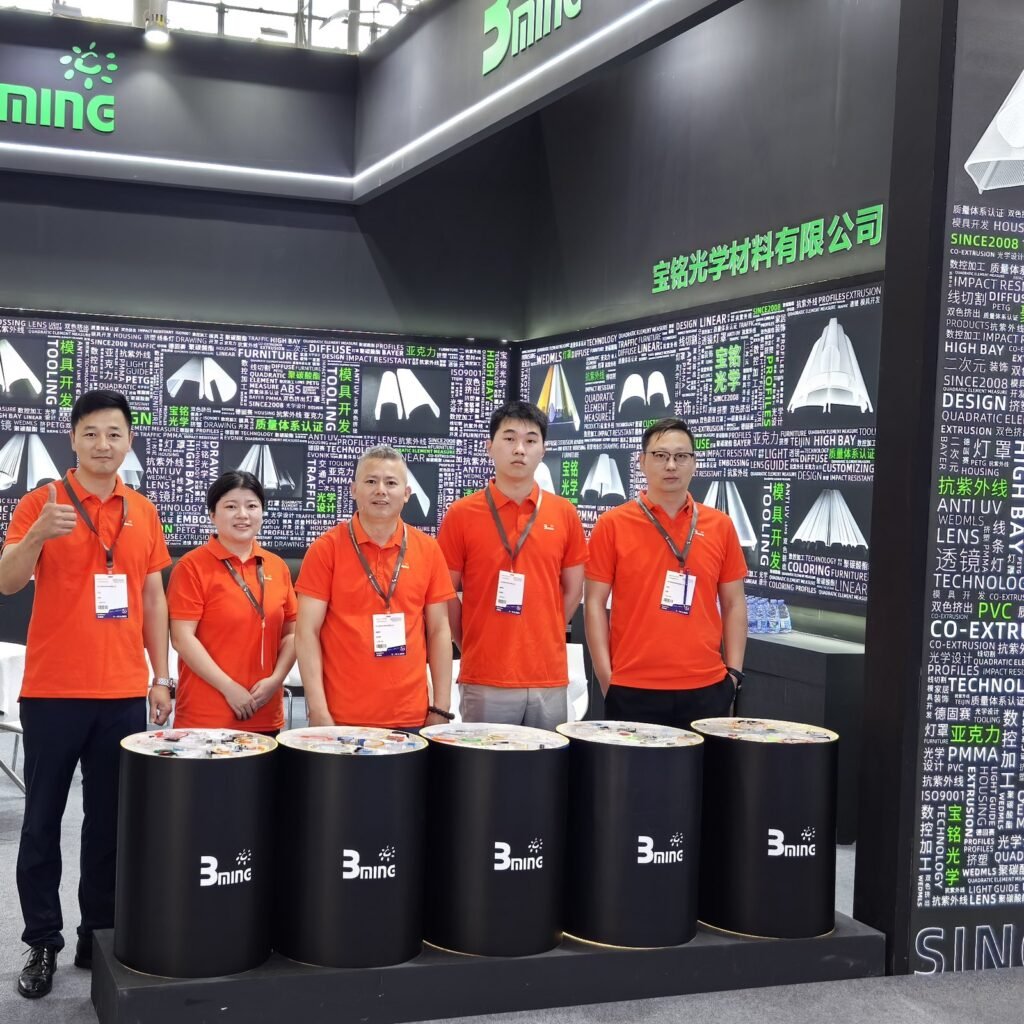
GILE is the show our calendar is built around. We exhibited in Guangzhou in 2018 and 2019, came back in 2023, and returned in 2025 for the fair’s 30th edition, which ran in June under a theme about lighting up everyday life. Six years of the same hall, and the questions have moved.
What was on the stand
The booth carried the range that pays the rent: PC and PMMA linear covers, prismatic and embossed covers, linear and optical lenses, and a wall of two-colour co-extrusion samples that drew most of the first-day traffic. Cut lengths of the popular sections sat in drums along the counter, because a profile that can be held and bent tells a buyer more than a catalogue page ever does.
Nothing on the stand was new for the sake of being new. The covers and lenses were the same sections we extrude every week, which is the point of a trade show for a contract manufacturer: the visitor is qualifying the supplier, not shopping for a concept.
The question that kept coming back
Across the three days, one topic dominated the counter: linear optics. Buyers working on continuous runs, office retrofits and retail fit-outs wanted to know how to keep an even wash of light along a fixture without visible LED pitch, bright edges or dark bands between luminaires. That is a distribution question before it is a product question, and it usually starts with mounting height and spacing rather than with a cover.
The trade-off behind it is the one specifiers run into again and again. Higher transmission looks better on a datasheet and worse in a finished ceiling, because what the eye judges is uniformity rather than total output. Our guide to how LED diffusers improve light distribution works through the mechanism, and the selection guide on transmittance and uniformity covers the compromise in detail.
Beam angle came up in almost every one of those conversations, which makes sense: a continuous run judged on how unbroken it looks pulls toward the wide end of the range, while a cove or a reveal wants the tight end. The beam angle selection guide has the matching table, and the linear lighting applications page shows where each band normally ends up.
Material questions, settled at the counter
PC or PMMA remains the first decision for most projects, and the answer depends on where the fixture lives. PMMA holds transmission and resists yellowing indoors; PC takes impact and wide temperature swings, which is why it dominates outdoor and industrial runs. The PC vs PMMA comparison sets out the split, and the PMMA diffuser pages carry the indoor range.
Where the conversation is pointing
The show’s own programme leaned hard on connected lighting: IoT control layers, AI driven scene management, fixtures that report on themselves. Whatever the control layer ends up doing, the optic still has to put light where the room needs it, and a smart driver cannot rescue a bad distribution. If anything, the trend raises the value of getting the optical part right at drawing stage, because a controlled fixture makes an uneven one more obvious, not less.
We left Guangzhou with the same conclusion as the last three shows: the market is drifting from covers that hide LEDs toward optics that do a specific job in a specific room. That is a better place for a contract extruder to be, because it is a conversation about tooling, sections and tolerances rather than about price per metre.
If you are working on a linear project and want a second read on the optical side, send the drawing. The companion piece on our Korea 2024 trip covers the other side of the calendar.
Frequently asked questions
When did GILE 2025 take place?
The 30th edition of the Guangzhou International Lighting Exhibition ran in June 2025.
What was on the stand?
PC and PMMA linear covers, prismatic and embossed covers, linear and optical lenses, and two-colour co-extrusion samples, with cut lengths of standard sections on the counter.
Do you exhibit at other shows?
Yes, regional shows through the year. The Korea International Light Convergence EXPO in June 2024 was the trip immediately before this one.