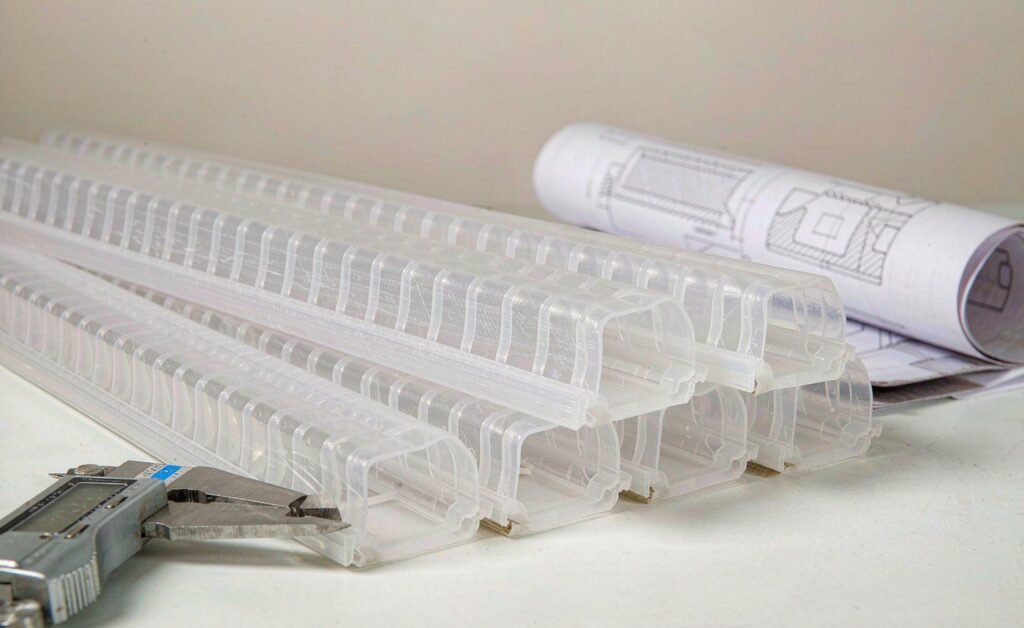
1. Why optical parts can’t be compared by “price per meter”
Two PC extruded covers may differ from tens of grams to over a kilogram per meter, and behind that sit four separate accounts: material, tooling, tolerance and yield. A quote without a drawing means the supplier is filling in the blanks, and the blanks get filled in their favour.
A quote usually hides five variables:
- Weight: the main engine of material cost, and the source of rigidity and assembly feel;
- Formulation: flame rating, UV resistance and diffuser system, which often move price more than the base resin;
- Tooling: the more complex the structure (multi-cavity, micro-structure, asymmetric snap), the heavier the amortization;
- Cut-to-length, packaging, shipping: extruded parts are bulky and light, so freight is often an invisible cost tier;
- Yield and scrap allocation: almost no supplier writes the scrap rate explicitly, but it is always in the unit price.
So the first round is about aligning assumptions: have every supplier quote against the same drawing, the same weight target and the same compliance set. Only then are the numbers comparable.
2. Four hidden bills of switching suppliers
1. Time. Re-development usually needs two to three sampling rounds, each plus logistics is two to four weeks. This bill is most expensive when a project window is tight, yet invisible in Excel.
2. Optical drift. The same cross-section made by different factories drifts in transmittance and haze, because the extrusion process and diffuser dispersion differ. The luminaire side then re-does photometry and customer approvals, which usually costs more than the unit-price saving.
3. Assembly. Snap dimensions, straightness and twist usually appear only as tolerance bands on the spec, and on the line they turn into cycle time and rework rate. Two extra minutes per assembler per day is real money over a year.
4. Tooling ownership. If tooling ownership isn’t clarified at kickoff, moving volume production elsewhere later gets blocked. The cost of asking one question before tooling is lower than litigation after.
3. Front-load uncertainty: a qualification drawing package
Almost all later disputes trace back to unclear requirements at inquiry stage. Make it a standard template sent to every candidate supplier:
- Profile cross-section (DWG / PDF), marking key dimensions and tolerances;
- Functional-face notes: defect tolerance for output face, mating face, decorative face;
- Material and color / haze target values;
- Target weight range (noted as target, not ceiling);
- Length, cutting method, packaging (film required? stackable?);
- Volume ladder: annual estimate, MOQ, first trial batch;
- Use environment and compliance (flame, RoHS, REACH, outdoor?);
- Whether batch traceability and shipment inspection report are needed;
- Sampling requirement: sample length, whether photometry validation on your own luminaire is required;
- Project milestones: sampling, approval, mass-production dates.
With this package, quotes line up against each other and later discussions have a shared baseline — which is the same expectation we apply when you request a quote.
4. How to judge a worthy extrusion partner
Skip the brochure; look at these five actions:
- Asks for the drawing before quoting. One that quotes full-range prices without a drawing can be dropped.
- Gives manufacturability advice. An extrusion engineer who knows the process raises wall-thickness equalization, fillet transitions and snap rebound margin before you ask, instead of taking the drawing as given.
- States its process boundaries clearly. The weight range it covers, the width it can form and the production scale: if these numbers match what the samples show, the interface is trustworthy.
- Commits to batch consistency. At least a clear sampling method and non-conformance handling; ISO 9001 is just the entry ticket.
- Ships enough sample length. One that only sends a ten-centimeter stub and won’t give enough to build your light likely lacks confidence in its own batch consistency.
Conversely, three signals suggest cutting losses: promising “all standards met”; giving only photoelectric data and no physical sample; a quote with zero stated assumptions.
5. Division of labor for engineers and procurement
The way to avoid “both sides assumed the other was managing” is to write the standard into one shared document:
- Engineer owns: the acceptance boundaries of optics and dimensions, meaning the transmittance–haze range, allowed colour and black-dot density, and the tolerance budget of key assembly dimensions.
- Procurement owns: the commercial boundaries, meaning tiered pricing, standard lead time, tooling ownership, annual reduction mechanism and minimum economic batch.
- One shared “spec freeze sheet”: any change goes through change evaluation rather than a verbal adjustment. Most “cost overruns” start from one undocumented verbal change.