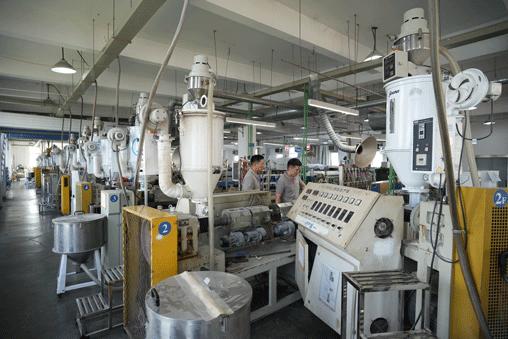
Extrusion is a continuous process. Understanding where the control points are explains why consistency depends on process discipline rather than end-of-line sorting.
1. Material preparation
PC and PMMA resin is identified and recorded by batch. Optical grades and UV-stabilised or flame-retardant compounds are handled separately, and drying conditions matter because moisture affects the surface.
2. Extrusion
The resin is melted and forced through the die that defines the cross-section. Die temperature, melt temperature and line speed are set together and then held steady — this is the core of the process.
3. Calibration and cooling
The hot profile is pulled through calibration tooling and cooled under controlled conditions so the section holds its dimensions.
4. Surface structure
Prismatic, embossed or frosted surfaces are produced by the die or by downstream embossing rolls, so the structure repeats identically along the whole run.
5. Cutting and post-processing
Profiles are cut to length, with mitring, notching, drilling or CNC machining where the assembly needs it.
6. Inspection and packing
Dimensions, appearance and optical consistency are checked against the approved sample before packing. Gloss and clear surfaces are protected with film, then cartons and pallets are labelled to the customer’s requirement.
Related products and applications
Need this profile made to your drawing?
We extrude PC and PMMA diffusers, covers and lenses from your drawing, sample or photometric target. Tooling is developed in-house.
Frequently asked questions
Why is consistency hard in extrusion?
Because the process is continuous: small drifts in temperature or speed show up as dimensional or optical variation. Control means holding parameters steady, not sorting at the end.
Can you produce prototype lengths?
Yes, from the production die, so the prototype represents the final profile.