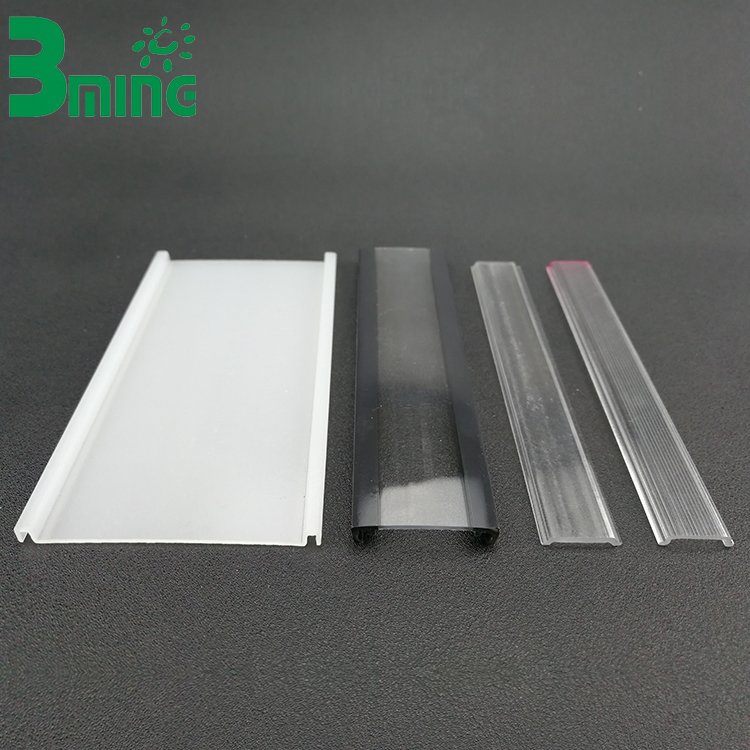
Both polymers are extruded into diffusers, covers and lenses. The specification question is which failure mode you cannot accept.
Where polycarbonate is specified
Industrial and warehouse fixtures, vandal-resistant luminaires, transport and public-area lighting, hot environments, and anywhere impact resistance is written into the specification.
Where PMMA is specified
Architectural interiors, commercial and office luminaires, signage, and outdoor applications where clarity and long-term colour stability decide the choice.
Comparison
| Polycarbonate (PC) | PMMA / acrylic | |
|---|---|---|
| Clarity | Very good | Excellent |
| Impact resistance | Very high | Moderate |
| Surface hardness | Moderate | High |
| UV stability | Good with stabilised grades | Very good |
| Service temperature | Higher | Lower |
| Typical use | Industrial, outdoor impact | Architectural, signage |
Combining both
Two-colour co-extrusion can combine properties in a single profile — for example a polycarbonate body with an acrylic face, or a diffusing face with an opaque reflector.
Related products and applications
Need this profile made to your drawing?
We extrude PC and PMMA diffusers, covers and lenses from your drawing, sample or photometric target. Tooling is developed in-house.
Frequently asked questions
Can PC and PMMA be co-extruded?
Yes, where the design calls for different properties in different parts of the profile.
Which is better for outdoor use?
PMMA for UV stability and yellowing; UV-stabilised PC where impact resistance also matters.