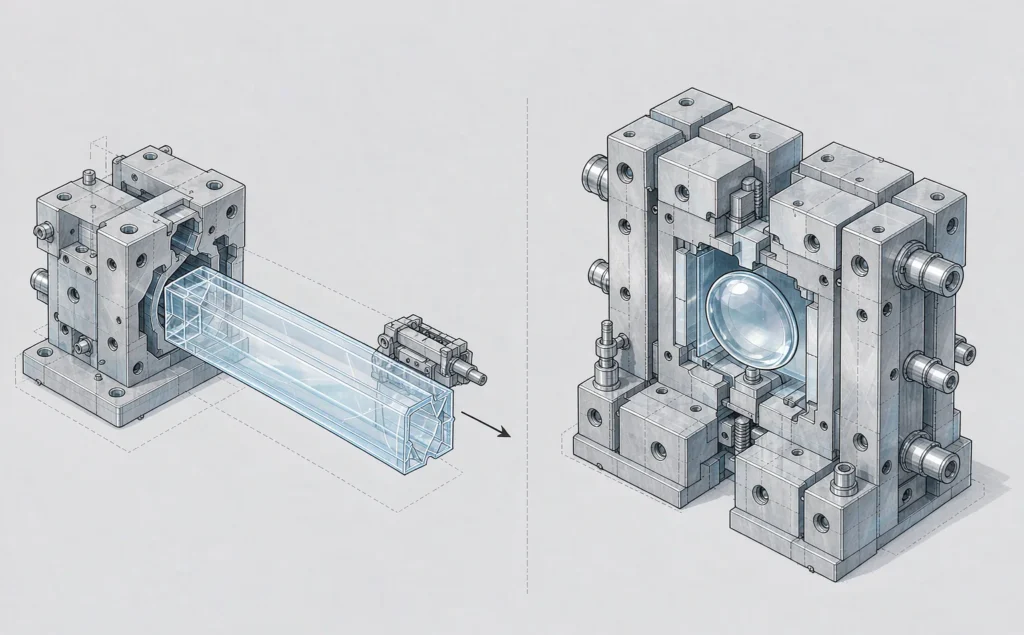
If you need a lens longer than about 300 mm and the section stays the same along its length, extrusion wins. It also wins when the section is likely to be revised during development, and when the first year order is in the thousands rather than the hundreds of thousands. Injection moulding wins on three dimensional features, on very short parts at high volume, and on surfaces that curve in more than one axis. Most of the drawings we see fall into the first group.
When a drawing arrives, the first question is not which machine will make it but what the section does, how long the part is, and how many will be ordered in the first year. Those three answers decide the process.
What an extruded lens actually is
Extrusion pushes molten polycarbonate or PMMA through a die with the profile shape cut into it. What comes out is a continuous length with a constant cross section, cooled and pulled, then cut. The section you approved is the section you get, metre after metre, in one uninterrupted piece. Our custom extruded lens work covers profiles from 10 g/m to 2,000 g/m, prismatic sections from 23 mm to 195 mm wide, and beam angles at 35, 45, 60, 85, 95, 100 and 105 degrees.
Because the profile is continuous, length stops being a constraint. A 600 mm troffer lens and a 2.4 m linear run come off the same die, cut to whatever the fixture needs. An injection tool large enough for a 2.4 m part costs more than most lighting programmes can justify, and even once it is built, the part it makes is one fixed length.
The two processes side by side
| Extruded | Injection moulded | |
|---|---|---|
| Section | Constant along the whole length | Can change in three dimensions |
| Length | Cut to any length from one die | Fixed by the tool |
| Tooling | A die, handled as a deposit against the order | A hardened steel cavity, amortised over volume |
| Formed features | None | Clips, bosses, end caps, snap fits |
| Minimum order | 500 pieces | Set by what justifies the tool |
| Section revisions | Die revision is cheap | A change means a new tool |
| Typical use | Linear runs, troffer lenses, continuous covers | Short parts at high volume, complex shapes |
Where injection moulding is the better answer
Moulding wins when the section has to change along the part: clip features, end caps formed in, mounting bosses, snap fits, a stepped profile, a lens that gets thicker at one end. Extrusion produces the same section all the way down the length and cannot add any of that.
It also wins on very short parts in very large volumes. Once the tool exists and the quantity justifies it, the cycle is short and the per piece cost falls hard. A 40 mm lens made in the hundreds of thousands belongs on an injection machine. The same part at 5,000 pieces does not.
And it wins where the optical surface has to be precise across more than one axis. A moulded lens can hold a compound curvature across its face. An extruded lens holds its shape across the section but will not hold a feature that varies along the length.
The tooling question
An extrusion die is a plate with a shaped opening. It is cheaper than an injection tool by an order of magnitude, and in our quotations it is handled as a deposit against the order rather than a cost you absorb in full. You can trial a section, measure it in a real fixture, revise the die and go again without the tooling budget becoming the argument.
An injection tool is a hardened steel cavity built to hold tolerances under pressure for hundreds of thousands of cycles, which is why it costs what it costs. A moulded programme needs its volume forecast settled before the steel is cut. Change the section afterwards and you pay for the tool again.
For a luminaire maker developing a new family of fixtures, this is usually the deciding factor. The first year of a linear range often involves two or three section revisions per size. Revising an extrusion die is routine. Revising an injection tool is not.
Length, MOQ and unit cost
Two numbers decide the crossover. As a rule of thumb, above roughly 300 to 400 mm extrusion gets cheaper per piece and stays there as the part gets longer. The second number is annual quantity. Our minimum is 500 pieces, well below the point where an injection tool starts to look reasonable, and daily output runs above 10,000 pieces once a profile is in regular production.
The money works differently in each case. An injection tool is a fixed cost you amortise, so the moulded part gets cheaper as volume climbs. An extrusion die is a small cost you barely notice, and the extruded part stays roughly flat in price, driven by material weight per metre and the length you order. At the volumes most linear lighting programmes run, the flat curve wins.
Section limits worth knowing before you draw
Wall thickness needs to be reasonably even. A section that jumps from 1 mm to 6 mm within a few millimetres cools unevenly, pulls out of shape, and gives you a lens that varies down its length. Even walls extrude straight.
Hollow sections need support. A fully enclosed profile collapses as it cools unless it is drawn with internal webs or the die is set up to hold it.
Sharp external corners round off in cooling. Give a prism tip a small radius instead of a knife edge and the beam you measure on the sample is the beam you get in production.
Two materials can run together. Co-extrusion puts a diffusing layer and a clear or opaque layer through the die in one pass, which is how opal over clear covers and two-colour profiles are made without a second operation. The capabilities page sets out what the lines are set up to run.
Optical consistency between batches
Buyers ask about consistency, and the question is reasonable. A continuous process drifts if it is left alone: melt temperature, pull speed and cooling all move. What holds it is measurement at fixed intervals and a die that has already been proven on an earlier run.
Transmission is specified between 0% and 97% depending on the compound and the section, and the figure is measured per batch rather than taken from the resin datasheet. If your fixture needs a particular beam, the beam angle page sets out how the angle is chosen and what it does to light on the working plane.
Five questions that settle it
Before the drawing goes out, answer these.
1. Does the section stay the same along the whole part? If yes, extrusion is in play.
2. Is it longer than 300 mm? If yes, extrusion is likely cheaper.
3. Does it need clips, bosses or end features formed in? If yes, it is a moulded part.
4. What is the first year quantity? Below the tens of thousands, an injection tool rarely pays for itself.
5. Will the section be revised during development? If yes, an extrusion die is far cheaper to revise.
If it is still a close call, send the section and the annual quantity together. The guide to designing a custom LED diffuser covers what to put on the drawing, and sending it over gets you a process recommendation with tooling and lead time options attached.
Frequently asked questions
How long can an extruded lens be?
There is no fixed upper limit. The profile is produced continuously and cut to the length the fixture needs, from short covers to runs measured in metres. Length tolerance is specified on the drawing.
What is the minimum order?
500 pieces, and that applies to custom sections as well as standard ones. It sits well below the volume where injection tooling begins to make sense.
Can an extruded lens have a prismatic surface?
Yes. Prismatic and embossed patterns are formed in the die and repeat along the length. Prismatic sections run from 23 mm to 195 mm wide, with pitch and prism angle set by the beam you need.
Can you make a two-colour or opal over clear cover?
Yes, by co-extrusion. Two materials run through the die together, so the diffusing layer and the clear or opaque layer are produced in one pass with no secondary assembly.