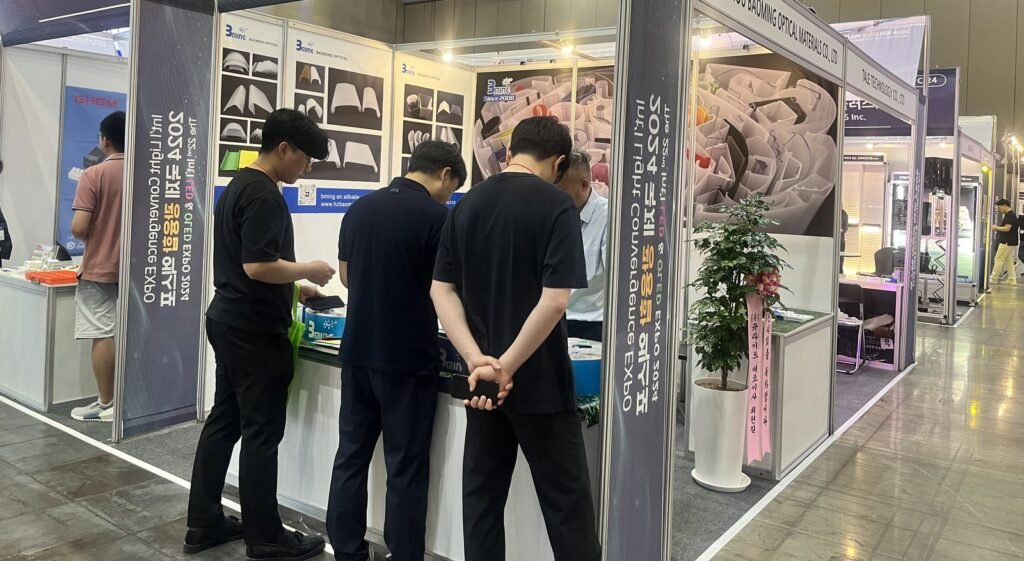
Between 26 and 28 June 2024 we exhibited at the International Light Convergence EXPO at KINTEX, the exhibition centre just north of Seoul, on booth H3-D26. It was the first time our embossed prismatic linear cover had been shown in Korea, and the first time the high-precision lens set had travelled with it. Three days at that counter said a lot about where the Korean market is heading.
Why the embossed cover exists
Put a clear cover over a dense LED array and you get exactly what the geometry promises: a bright line with the position of every LED visible through it. The embossed prismatic structure breaks that line up. Each ridge redirects light before it leaves the profile, so the output arrives at the ceiling and the wall as a wash rather than a row of points, and the fixture stops reading as a light source and starts reading as a surface.
The same structure does the unglamorous work that matters in offices and commercial interiors. High-angle rays, the ones that bounce off the optic and straight into a seated viewer’s field of view, get folded back into useful directions. The finished glare figure is computed for the luminaire in the room rather than for the cover on its own, which is why the low-UGR specification guide starts with the room model instead of a product number. For the structure itself, the prismatic diffuser explainer covers how the prisms are laid out.
What plant lighting engineers asked
The second question at the counter came from growers and fixture builders working on plant lighting. Their problem is rarely total output; it is getting light onto a canopy evenly, at a height, for sixteen hours a day. That is an optics problem with a thermal budget attached.
The lens series we brought answers the first half. Extruded linear lenses in beams from 35° to 105° let a fixture builder put light exactly where the canopy sits instead of spraying the room, and the beam angle selection guide works through how to match the angle to mounting height and spacing. The optical LED lens range carries the sections themselves.
The second half is where the cover earns its place. A fixture that runs half the day sits warm, and a profile that sags or grows under that load stops holding the geometry the optic was designed around. The temperature effects guide covers sag, cold and expansion, and it is the document we point growers to before they commit to a long continuous run.
A cover that filled a gap
Korean visitors read the embossed prismatic cover as the missing middle of their market. Clear covers were everywhere and heavy opal diffusers were everywhere, but the section between them, the one that hides LED pitch while keeping useful transmission, was mostly being imported or tooled locally. Several of the conversations at the counter ended the same way: a section sketch, a target width, and a request for a quotation against an existing drawing.
That pattern is the reason we travel. A trade show is the fastest way to find out whether a section that sells in Guangzhou also sells in Seoul, and this one did. The linear lighting applications and commercial lighting applications pages carry the project types where the cover normally lands.
If the cover looks like the missing middle of your own range, send a drawing or a section sketch and the quotation will come back with material, tooling and lead-time options attached.
Frequently asked questions
What does an embossed prismatic cover actually do?
Its surface structure redistributes light instead of just hiding the LEDs. It evens out distribution along the fixture, softens the visible bright line, and folds high-angle rays away from the direct viewing field.
Can a diffuser supplier promise a UGR value?
No, and any supplier who does is guessing. UGR is computed for the finished luminaire in a specific room, so the same fixture can compute different values in different spaces. What a cover can do is give the optic the tools to hit the target.
Do you supply lenses for horticultural lighting?
Yes. High-precision linear lenses in beams from 35° to 105°, specified against canopy height and fixture spacing, with the cover chosen for continuous warm operation.