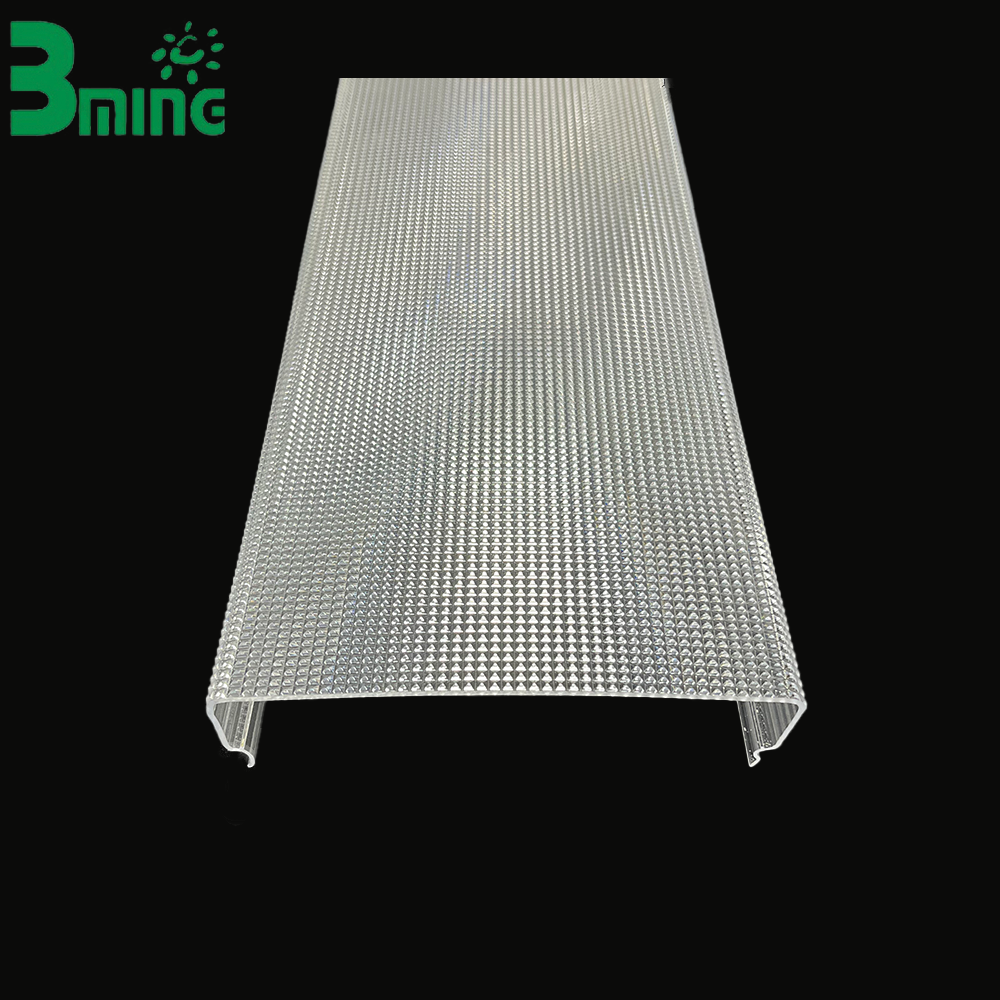
A prismatic diffuser does not just scatter light — it redirects it. That difference is what lets a fixture meet a glare limit without giving up output.
How a prismatic surface works
The extrusion die carries a prism geometry — a repeating ridge or lens structure on the surface. Light leaving the profile is refracted at each facet, so the distribution is shaped rather than randomised. Because the geometry is machined into the die, it repeats consistently over the whole production run.
What it delivers
The practical benefit is glare control at a higher transmission. A frosted cover of the same size has to scatter more light to hide the sources, and scattering costs lumens. A prismatic surface redirects light where it is wanted instead.
Where it is used
Troffer and panel luminaires in offices are the classic case, because glare standards and energy targets both apply. Prismatic surfaces are also used in commercial downlights, low-bay industrial fixtures and any application where a viewing-angle limit is specified.
Custom prism geometry
Prism pitch, depth and angle can be developed for a specific photometric target. The structure is cut into the die, so a custom geometry is a tooling project rather than a process change — and prototype lengths come from the same die as production.
Related products and applications
Need this profile made to your drawing?
We extrude PC and PMMA diffusers, covers and lenses from your drawing, sample or photometric target. Tooling is developed in-house.
Frequently asked questions
Does a prismatic diffuser reduce light output?
Less than an equivalent diffusing frosted cover, because it redirects light instead of scattering it.
Can the prism pattern be customised?
Yes. Prism pitch and angle can be developed for your photometric requirement.