A tender gets rejected because someone sat at the mock-up desk, looked up, and said the luminaire hurts. The lumens were on target and the efficacy was fine. By that point the LED choice is frozen, the heatsink is frozen, and the only part anyone can still change is the piece of plastic over the LEDs.
That is the position a low-UGR LED diffuser is specified from. Glare is judged in the first three seconds a person spends under a fixture, and it depends mostly on how the optical part handles high-angle luminance.
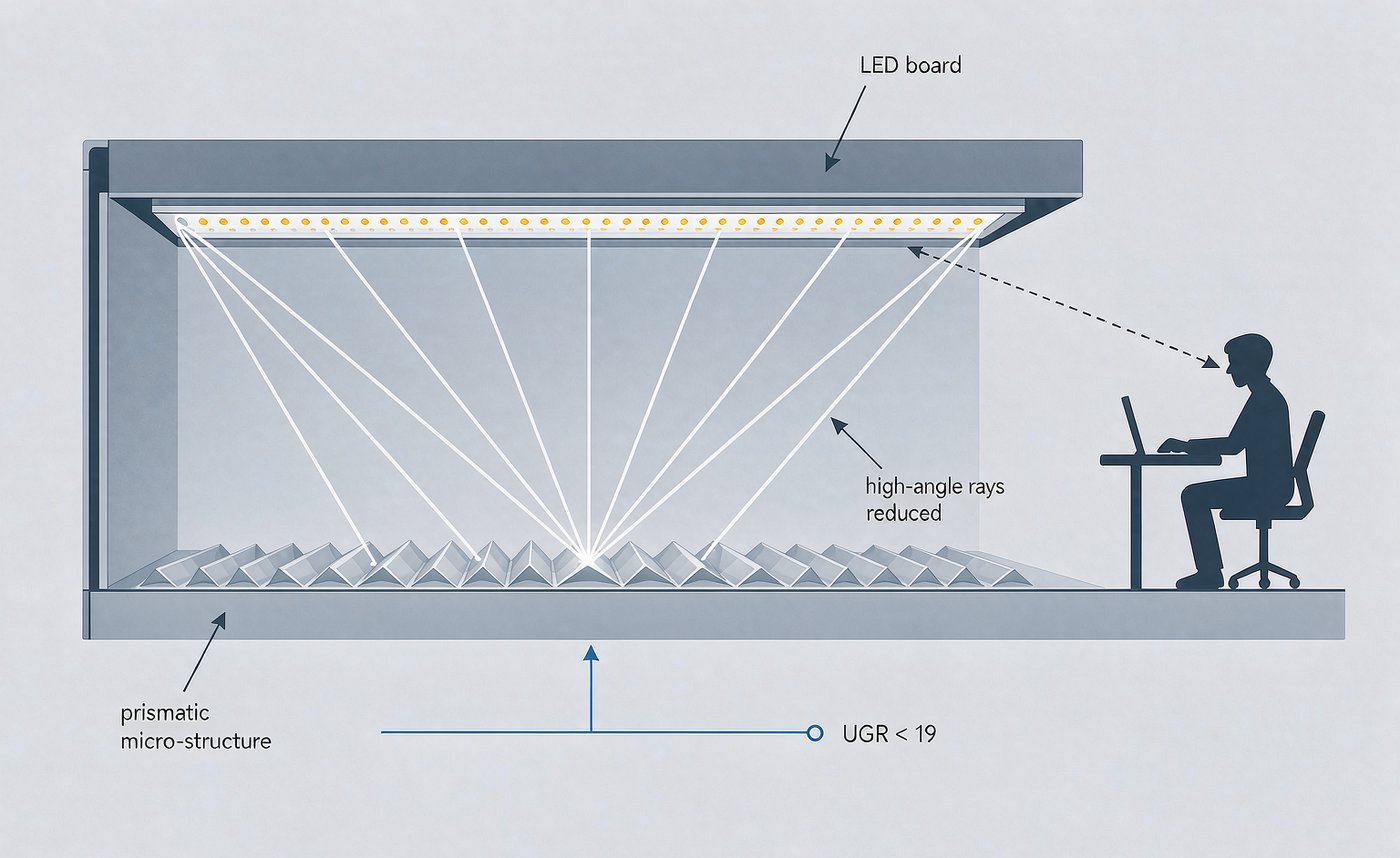
Why glare is decided by the diffuser, not the LED
LED chips are bright, brighter per square millimetre than any light source that came before them. A bare LED board is a row of point sources, and a point source viewed directly is uncomfortable at almost any output. The diffuser does two jobs at once:
- It spreads the emitter area. Light is scattered so the apparent source becomes a surface instead of a dot, which drops luminance (cd/m²) at every viewing angle.
- It sets where light goes. The diffusion agent, the profile geometry and any prismatic or lens structure decide how much energy leaves the fixture at 65°, 75° and 85°, which are the angles that land in a seated person’s eyes.
Deliver the first job and miss the second, and the fixture still fails. A diffuser can hide every LED dot and produce a surface that looks even while remaining blinding at high angles, because scattering has no direction preference. Reaching UGR<19 takes deliberate control of the angular distribution.
What UGR measures, and where it stops being useful
Unified Glare Rating is a calculated comfort index, not a measurement taken with a probe. The standard office target is UGR < 19 (EN 12464-1 for indoor workplaces; IES LM methods sit behind it in North American practice). The calculation takes:
| Input | Where it comes from |
|---|---|
| Luminance of the luminaire at the observer’s eye | Fixture optics, meaning your diffuser |
| Apparent solid angle of the emitting area | Diffuser size and how evenly it lights up |
| Background luminance | Ceiling, wall and desk reflectances |
| Position index | Observer location vs. fixture in the room |
Two things follow from this. First, the optics dominate: diffuser luminance enters the equation directly, so halving the luminance visible from a seated position moves the number more than most downstream fixes. Second, UGR depends on the room, not just the product — so no supplier can honestly promise “UGR<19" without knowing ceiling height, reflectance and layout. Ask for the photometric file and recalculate in your own room model rather than accepting a single number printed on a datasheet.
Three levers you control in the optical part
1. Diffusion level vs. transmission efficiency
Extruded PC or PMMA gets its diffusion from a dispersed agent inside the resin. More agent means lower surface luminance and better hiding power, while every extra scattering event sends some light back into the fixture and some toward the ceiling. That is the trade-off covered in the transmittance vs. uniformity discussion. The target is the minimum diffusion that still hides the LED pitch at your actual mixing distance.
2. Prismatic structure for high-angle cut-off
A prismatic diffuser uses a micro-structured surface to redirect light rather than scatter it. Prisms can be tuned to pull energy away from 70–90° and push it toward the working plane, which lowers perceived glare and often *raises* useful illuminance. It is the most effective tool for UGR targets in open offices and troffer lighting, where the fixture sits directly in the field of view.
3. Lens-assisted beam shaping
Where the diffuser alone cannot reach the target, adding a secondary optic does. A linear LED lens or batwing distribution moves peak intensity sideways, spreads flux further and reduces on-axis punch. It also buys tolerance: with the lens handling the angular work, the cover can stay open and efficient instead of being pushed into a heavy diffusion that costs 10–15% output.
Values worth writing into your drawing
Ambiguity here is what creates claims later. These are the items that belong in the optical spec:
- Target UGR value and the room model it applies to: ceiling height, spacing-to-height ratio and reflectances.
- Maximum allowed luminance at 65°/75°/85° in cd/m², not just “low glare”.
- Transmission target as a range, for example 70–80%, rather than a single maximum. A single number tempts the supplier to buy diffusion with flux.
- Haze / hiding criterion stated against your LED pitch and mixing distance, not in isolation.
- Colour consistency: ΔE or MacAdam bin expectation between batches, since a visible tint difference reads as a quality defect even when the optics are fine.
- Angular distribution requirement if you are using prismatic or batwing optics, best expressed as a reference IES/LDT file.
Mistakes that cost the most
- Specifying “high transmittance” as the headline requirement. It pushes hidden diffusion levels down and glare up, in exactly the applications where glare matters most.
- Approving optics from a benchtop look. Glare is judged installed, at height, at the worst seat. Always do a ceiling-mounted mock-up.
- Treating UGR as a property of the luminaire alone. The same fixture can compute UGR 16 in one room and UGR 22 in another.
- Freezing the cover last. If the diffuser is chosen after the housing and LED layout are locked, you have removed the cheapest lever you had.
Matching optic type to the space
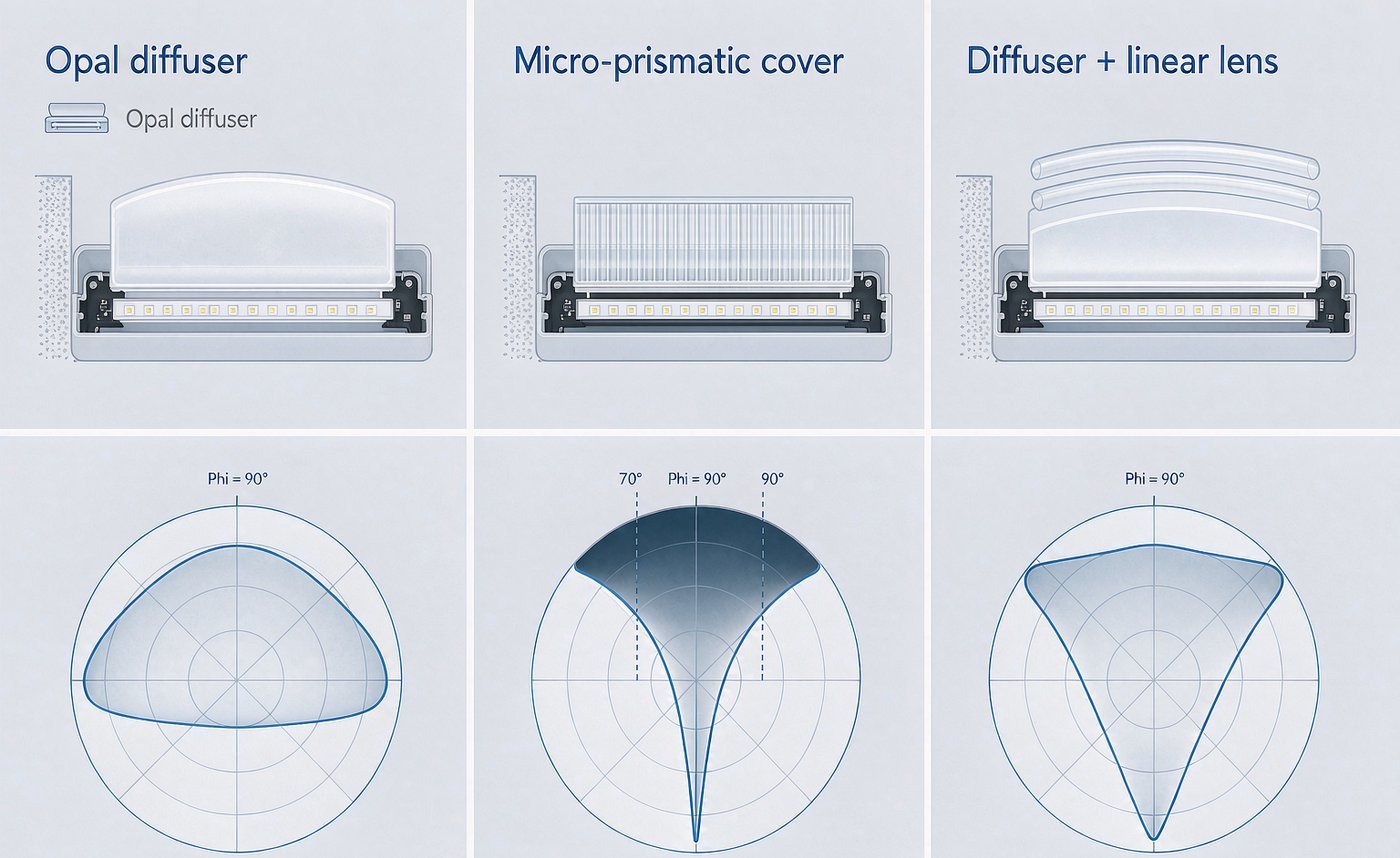
| Application | Typical starting optic | Notes |
|---|---|---|
| Open-plan office, seated task | Prismatic or micro-prismatic cover | Prioritises high-angle cut-off over raw transmission |
| Cellular office / meeting room | Opal diffuser, moderate diffusion | Viewing angles less aggressive; evenness matters more |
| Education, healthcare corridors | Prismatic with wide spacing | High occupancy-sensitivity to discomfort glare |
| Retail, hospitality feature lines | Clear or lightly frosted + lens | Glare controlled by shielding and aiming instead |
Getting from requirement to approved part
The sequence that avoids rework runs like this: set the target UGR and the room model, derive the angular distribution it needs, shortlist the optic types that can produce it, request photometric files and recalculate them in your own model, then order physical samples for a ceiling-mounted review.
Baoming Optical extrudes custom LED diffusers, prismatic covers and matching lens profiles, so the angular distribution and the cover are developed against one photometric target instead of being reconciled afterwards. Send the room model, LED pitch and target values with a drawing to request a quote. Fixing UGR at drawing stage costs less than fixing it at second tooling.