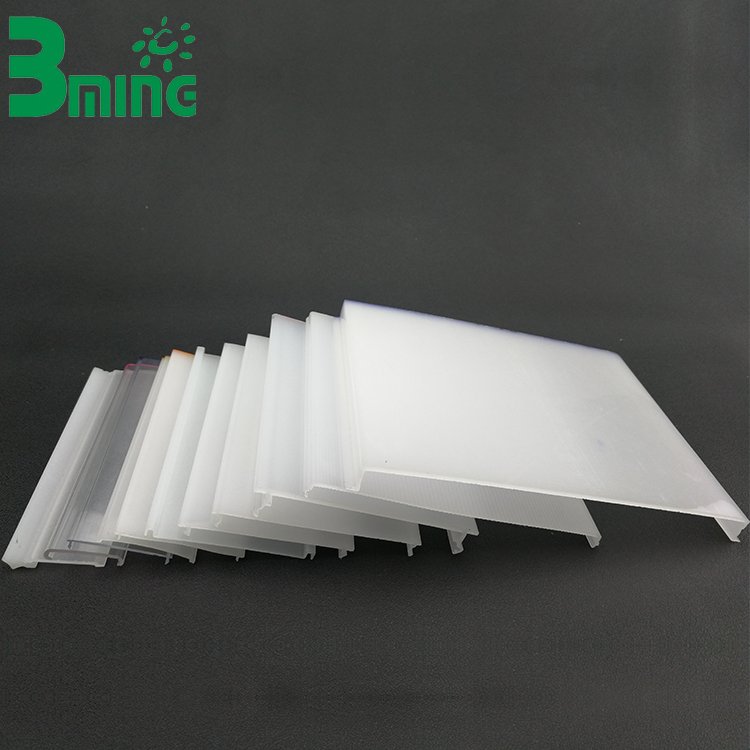
PC and acrylic diffusers can look identical on a drawing and behave very differently in a fixture. Here is what actually changes when you switch between them.
Optics
Acrylic gives higher clarity and lower haze, so it is the better choice where the surface is seen close up or where maximum transmission matters. Polycarbonate transmits very well but with slightly more haze, which also helps diffusion.
Mechanical behaviour
Polycarbonate is dramatically tougher. For industrial fixtures, vandal-resistant luminaires, transport applications and anywhere the diffuser can be struck, polycarbonate is the safer specification. Acrylic is rigid and hard but will crack where polycarbonate deforms.
Surface and handling
Acrylic has a harder, more scratch-resistant surface. Polycarbonate is softer and more susceptible to scuffing, which is why protective film and packing matter more. Cutting, machining and cleaning procedures differ accordingly.
Temperature and fire
Polycarbonate has a higher continuous service temperature. Flame-retardant grades are available in polycarbonate; where a specific flammability rating applies, confirm it for the target market before specifying.
Processing and tooling
The two materials flow and shrink differently. A die cut for one will not automatically run the other, so a material change should be treated as a re-qualification with prototype lengths, not a substitution.
Related products and applications
Need this profile made to your drawing?
We extrude PC and PMMA diffusers, covers and lenses from your drawing, sample or photometric target. Tooling is developed in-house.
Frequently asked questions
Can I replace an acrylic diffuser with polycarbonate one-for-one?
Not usually without re-qualification. Trial lengths should be produced and measured first.
Which is cheaper?
Resin price is only part of the cost; yield, packing and handling requirements differ. Compare a quotation for the finished profile, not the raw material.