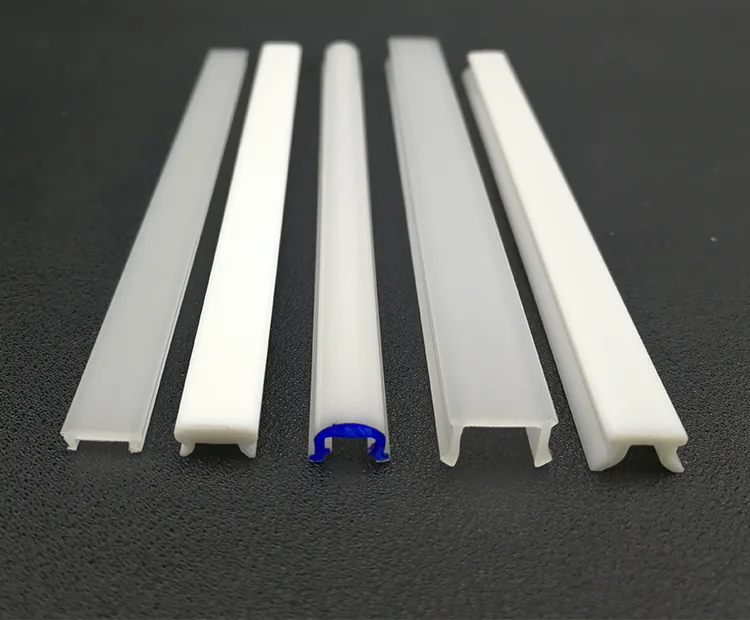
Custom LED optics is a loose phrase until you put it next to an extrusion line. Buyers use it for anything from a tinted cover to a lens that sets a beam. An extruder hears something narrower: one cross section, repeated along a continuous length, cut to whatever the fixture needs. Everything custom about the part sits in that section. Length is a cutting instruction, not a design decision.
If you are sourcing the part, that distinction saves a round of samples. It tells you what to ask before tooling and when a request is really a moulded part in disguise. Most drawing revisions we see start from one gap: buyer and die shop did not agree on what custom covered. We have extruded optical profiles since 2008.
What custom covers, and what it does not
Custom does not mean a unique part for every luminaire. It means the die is cut for your section instead of a catalogue section. Once it exists, that section can run in PC or PMMA, clear, frosted or prismatic, and cut to 600 mm or 2.4 m without another tool. A different flange, wall or snap detail is a section change, and that is the level at which custom is priced.
What custom never covers is a section that varies along its length. Extrusion pushes resin through one shaped opening, so the geometry at the first millimetre is the geometry at the last. Formed clips, bosses, sealed ends and stepped thickness belong to injection moulding. If your drawing has any of them, settle that early; the extrusion vs injection moulding comparison sets out the decision in one table.
A lens that is 3 mm thick at one end and 6 mm at the other is two parts, not one custom optic. A new prism pitch on an existing channel is a normal die revision.
The four variables you actually control
Four inputs decide what comes off the line. If one is missing, the supplier fills the gap with a default, and that default shows up in your luminaire.
| Variable | What you put on the drawing | What it changes | What the extruder needs from you |
|---|---|---|---|
| Cross section | Width, height, wall, radii, snap features, mating faces | Light exit window, mixing distance, weight in g/m, assembly fit | The housing print, with functional faces marked |
| Resin and compound | PC or PMMA, UV stabilised or flame retardant grade, colour | Transmission, impact and heat behaviour, material cost | Use environment and the compliance list for the destination market |
| Surface structure | Prismatic, embossed, frosted or clear, with pitch and angle | Beam spread, glare, how well LED dots are hidden | A target beam angle or a uniformity value measured on your fixture |
| Length and ends | Cut length, cut tolerance, mitre, notch, drilling, end cap fit | Seam appearance, gasket fit, packing density | The end cap or gasket drawing, not just a nominal length |
The section is where the optical work happens. The other three rows are where projects slip. A drawing that gives width and length but leaves wall thickness to a general tolerance produces a profile whose weight drifts between batches, and weight moves the optical path as well as the price.
Optical targets you can hold a supplier to
Translation is specified between 0% and 97% depending on the compound and the section. Profile weight runs from 10 g/m to 2000 g/m. Prismatic covers are formed from 23 mm to 195 mm wide. Available beam angles are 35, 45, 60, 85, 95, 100 and 105 degrees. Those are the ranges a custom LED optics enquiry can start from, not a set of values you should copy onto a drawing.
Pick the number that decides acceptance and write down how it will be measured. Sheet transmission says little about uniformity in a fixture with your LED pitch and mixing distance. Agree before samples ship whether acceptance is whole luminaire uniformity on your bench or a supplier measurement on the sheet, then name the instrument and the sample length.
Ask for readings per batch rather than one first article report. A continuous line drifts when melt temperature, pull speed or cooling move, so the useful evidence is a run of measurements at fixed intervals. The custom diffuser manufacturing guide covers where that drift starts, and the extrusion capability page lists what runs in house, including 20+ extrusion lines.
Compliance is a separate conversation from optics. The factory quality system is certified to ISO 9001:2015 (CQC certificate 00124Q34175R1S/3300, valid to 2027-05-16), which covers the system, not the finished luminaire. Flammability, RoHS and electrical requirements must comply with the standards your destination market asks for. The UL Component Plastics yellow cards E242424 and E300275 are material level recognitions and do not certify an assembled fixture.
Tooling, minimum order and volume
An extrusion die is a plate with a shaped opening. It costs far less than an injection cavity, and in our quotations it is handled as a deposit against the order. You can trial a section, measure it in the real housing, revise the die and go again without the tooling budget becoming the argument. That is why a luminaire family with two or three section revisions per size stays on an extrusion line.
The minimum order is 500 pieces, for custom sections as well as standard ones. Daily output runs above 10,000 pieces once a profile is in regular production. Length does not change the die, so one tool serves a whole range of fixture sizes. Ask at quotation stage who owns the die and what a revision costs.
| Ask before tooling | Why it matters | A usable answer contains |
|---|---|---|
| Which dimensions are functional, and which band applies to each | General tolerances protect shippability, not your light output | Named dimensions with bands, plus a measuring length for straightness |
| What value decides optical acceptance, and who measures it | Deciding after samples arrive costs weeks | One number, one method, one instrument, one sample length |
| How many sampling rounds the section is likely to need | Photometry and assembly fit rarely converge in round one | A written plan with a date for each round |
| What the tooling quote includes and who owns the die | Ownership decides the cost of a later supplier change | Deposit terms, revision cost, ownership in writing |
| How batch readings are recorded and shipped | A good first sample is not a stable production run | Interval, record format, and what happens on a non conforming batch |
A short pre-RFQ checklist
- Cross section drawing with functional faces marked, plus the housing print it mates with.
- Material, surface structure and target optical value, each written as a number with a measurement method.
- Cut length, cut tolerance and end cap or gasket condition.
- First year quantity and the compliance list for the destination market.
- The five answers from the table above, agreed before the die is cut.
Attach that package to your request a quote and the reply will describe your luminaire instead of a catalogue. If you are choosing between a modified standard section and a new die, custom LED diffuser profiles shows what a section built around a housing print looks like. Decide the geometry first; everything else in the quote follows from it.
Frequently asked questions
What is the minimum order for a custom section?
500 pieces, the same as for a standard profile. It sits well below the volume where injection tooling starts to make sense, so a first year in the low thousands is a normal extrusion programme. Length within that order is free, since the profile is cut after extrusion.
Can an extruded optic have a prismatic or lens surface?
Yes. Prismatic and embossed patterns are formed in the die or by downstream rolls and repeat along the whole length. Prismatic covers are formed from 23 mm to 195 mm wide, and beam angles of 35, 45, 60, 85, 95, 100 and 105 degrees are available. State the pitch and angle you want, or give the beam you need and let the die shop propose them.
Does custom mean the section can change along the length?
No. Extrusion produces one constant section. Clips, bosses, sealed ends, steps and compound curvature in more than one axis are moulded features. If the drawing needs them, the part belongs on an injection machine, and it is cheaper to find that out before a die is cut.
What should I send to get a usable quote?
A cross section drawing with functional faces marked, the housing print, the material and surface structure, a target optical value with its measurement method, cut length and end condition, first year quantity, and the compliance list for your market. A supplier who quotes from a length and a photograph alone is guessing at the two things that drive cost, which are the section weight and the tooling.